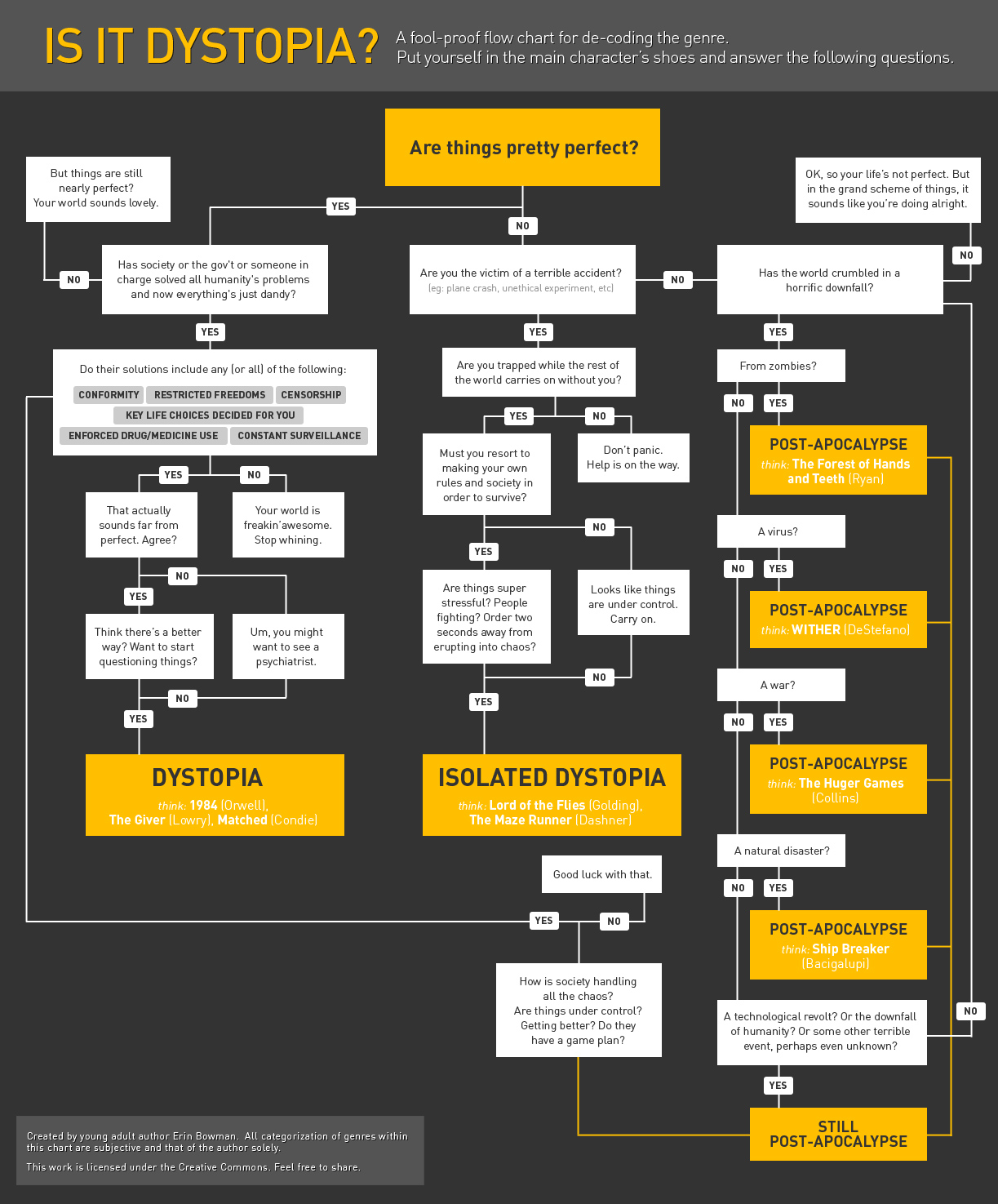
Is it dystopia? A flowchart for decoding the genre

14 July 2011

A few days ago, the lovely Maureen Johnson started a conversation on twitter about the dystopian genre and how it is defined. An #isitdystopia hashtag emerged. There were talks of flowcharts. One made the rounds, and while it was amusing and had me smiling, it made me think more critically about how I define the dystopian genre.

Personally, I believe that a true dystopia, at its core, has a lot to do with the main character discovering a fatal flaw in their otherwise perfect society. This means that at a book’s opening, the MC is usually blind to the injustices of their world. As readers we often see red flags off the bat, but the story becomes a journey, with the character moving from satisfied, to suspicious, to conflicted, and finally to aware, where they have some sort of realization that their world is far from perfect. Sometimes they even rebel. A good writer friend, Robison Wells recently ran a What is Dystopia 5-day series on his blog. There is some really great, insightful information in the five posts, and I tend to agree with him on almost everything.

So if a dystopia is the perfect world in which the main character discovers fatal flaws, other books such as Carrie Ryan’s THE FOREST OF HANDS AND TEETH, is truly a post-apocalyptic story. Sure that book has the undertones of a dystopia – the Sisterhood is overbearing and asks citizens to blindly follow their rules – but at the end of the day, Mary knows she is not living in a perfect world. And she knows this right from the opening page. Things are BAD. And that is the key differentiator, in my opinion. A “bad” place is not all that defines a dystopia.

That is not to say that a book set post-apocalypse can’t have a bit of dystopia in it. THE HUNGER GAMES is definitely part post-apocalyptic, part dystopia. So is WITHER. But both worlds rose out of a downfall of humanity.

All this thinking lead to a flow-chart on my end.

Again, I really think a true dystopia comes down to the illusion of a perfect world as seen through the main character’s eyes. So pretend you are the main character, as they exist at the beginning of a book, when you tackle this flow chart. And remember this is all subjective. This chart represents my opinions, and mine alone. (click it to view full size)

Is it Dystopia? a flowchart for de-coding the genre by Erin Bowman

Creative Commons License
Is it Dystopia? A flowchart for de-coding the genre by Erin Bowman is licensed under a Creative Commons Attribution-NonCommercial-NoDerivs 3.0 Unported License. Based on a work at www.embowman.com. Feel free to share it for non-commercial uses.

So what do you guys think? Agree? Disagree? I think all the confusion and blurring lines has come from the mere fact that this genre – and anything similar to it – has been flying off the shelves lately. Leave your thoughts in the comments; I’d love to hear them!

  • http://www.sarahenni.com Sarah

    This flow chart is amazing!! I love the “Stop whining!” result :)

    • Erin

      Haha. Thank you! I had to bring in a little humor when talking about the end of the world and oppression and such. :)

  • http://www.bruceeschler.com bruce eschler

    This is great for three reasons. First, I like flowcharts. Second, this is helpful for writers who are trying to find comparisons to the book they’re writing, pitching, or marketing. Lastly, I could use this to help my students understand the differences between the books their reading. Thank you all on three counts.

    • Erin

      You are most welcome! So glad it was helpful.

  • Ello

    Nice job! I like it, although I always thought dystopia had to have a repressive, controlling government as a major component. Which is why I think HUnger Games is dystopian.

    • Erin

      I completely agree about the oppressive government. I think Hunger Games is an even split. The one reason I would categorize it as a post-apoc first, and a dystopia second, is because we know upfront that Katniss lives in an imperfect world. She tells us about the war that left the country in it’s current state (Capital vs Districts), and her and Gale talk endlessly about how terrible the state of things are (the Games). That being said, HG is definitely a more even split between PA and D than say something like The Forest of Hands and Teeth.

      Anyway, thank you for stopping by! Love these discussions.

  • http://yahongchi.blogspot.com Yahong

    I’m glad you pointed out Wither! I always thought it wasn’t a dystopian because there isn’t really a covertly corrupt government; girls get kidnapped and murdered nowadays too. I actually labelled it as sci-fi since that’s what triggered an entire generation to wipe out — but the world didn’t exactly end.

    But OH MY GOD that flowchart is EPIC. Love the “Um, you might want to see a psychiatrist” :D And the examples are awesome. I’m not sure how the “still post-apocalypse” at the bottom leads to the “how is society handling the chaos?…” box nearby, though, could you explain?

    • Erin

      So all the post-apocalypse boxes are supposed to lead to that final question, but I can see how it’s confusing. Basically, I’m trying to show that even in PA, there is a good chance that as society tries to “fix” things, they end up creating a dystopia from the shell of the country.

      That’s why those PA gold boxes all lead into: “how is society handling all that chaos? do they have solutions?” If so, “are they oppressive?” If so, that’s a dystopia IN a PA world. Make sense? Maybe I need to add some arrows so all the PA boxes look like they are pointing to that final chaos question.

      Anyway, glad you liked the chart! :)

  • http://emy-shin.blogspot.com Emy Shin

    I want to link this post and spread this flow chart all over the YA blogosphere! Truly awesome post, Erin!

    With the expansion of the dystopian subgenre in YA, I’ve read a lot of novels labelled “Dystopian” that are, in fact, not dystopia. In its simplest form, a dystopian society is an utopian society gone wrong. If there’s no pretense (at least for the protagonist) of a utopia, then there cannot be a dystopia.

    Of course, the definition of a genre can certainly evolve over time. It seems YA dystopian itself is a quickly changing subgenre. Still, when I see “dystopia,” I come in with certain expectations — and it can be disappointing (or perhaps slightly frustrating) when I find out, no, it’s not dystopia after all but post-apocalyptic or futuristic. (Not that I don’t adore subgenres as well — I have so much hearts for sci-fi — but it’s just the expectation of things.)

    It was, to a smaller extent, the same with YA paranormal romance. Because it in itself is so huge, so many urban fantasy or contemporary fantasy are lumped together with paranormal, when they aren’t really paranormal.

    I don’t believe that a novel has to fit neatly into a genre, but if sometimes, they’re just mislabeled.

    Sorry for such a long comment. :)

    • Erin

      Thank you, Emy! And you can, and SHOULD, link the flow chart around the interwebs. I licensed it for free noncommercial use, so as long as it’s posted and linked back to me, it can be shared all over!

      I completely hear you about subtle sub genres being lumped together. And I am 100% with you that not all books need to fit neatly into one category. I do though, like you, get a little annoyed when I hear something called X, only to find out that it is 10% X and 90% Y. I felt that way with Ryan’s FOHAT. That book is mostly post-apocalyptic, and then maybe a bit horror, and then maybe a tiny bit dystopic. I still enjoyed the book, but I remember thinking to myself, “This is NOT a dystopia.”

      So that’s why this flowchart came to be, I guess. Because I have some basics I, personally, use when I evaluate a genre. And since the dystopian genre (and anything similar) is growing so hot, it seemed worth addressing.

      Also, do not worry about the long comment. I left one too! It’s great. It means we’re having fantastic discussions :)

  • http://katyupperman.com Katy Upperman

    Erin, this is fantastic! Thanks for clearing up a lot of misconceptions about these genres that many seem to think are interchangeable. And wow… it’s so pretty!

    • Erin

      Thank you! I’m glad it is both pretty AND useful ;)

  • http://www.tamlinsey.com Tam Linsey

    Interesting distinction. I think a lot of dystopia will, of necessity, emerge from a post apocalyptic setting, but I like the distinction about the protagonist being unaware things are not perfect. I blogged about dystopia a while back, too, and my definition was: Dystopic characters start out as ordinary people, oppressed by the world they live in. People like you and me facing enormous odds. Then they find an inner strength they didn’t know they had and they use it to change the world. Thanks for the chart!

    • Erin

      Yes! I completely agree that many dystopic worlds will arise from a post apocalyptic setting. Often in those worlds, the characters already know the world has crumbled an things are badbadbad. That was the crucial point I chose to focus on when distinguishing those types of tales from a “true” dystopia (where characters at first believe they live in a utopia). I like your additional character distinction — the dystopic character starting out as an everyday Joe in their oppressed world, and eventually finding inner strength to change things.

      Thanks for stopping by and sharing your thoughts!

  • Lizzie Newell

    Amusing flow chart, but for me it fails to answer if a story is dystopian or not.

    I’ve understood dystopian stories to be extrapolations of existing problems magnified horrifically. Examples: The Time Machine, Brave New World, Handmaid’s Tale, 1984, Dark City, The Matrix, THX1138.

    True dystopian stores tend to be truly depressing. As in Brave New World, the hero, in despair and unable to save the world, commits suicide.

    But the opposite of dystopia, utopia is boring. No problems means no conflict and no plot.

    Following this chart all fantasy/science fiction stories come out as a variety of dystopia. Which makes the label useless. But maybe this chart distinguishes post-apocalyptic from the rest of dystopian fiction, a bit too much hairsplitting for me.

    I tried to apply the chart to my own stories, which I do not consider to be either dystopian or post-apocalyptic, but those are the only options presented. I can fudge my answers to get either post-apocalyptic or dystopia, but neither label works.

    I think maybe all SF stories exist on a spectrum between the poles of dystopia and utopia. I propose that those on the dystopia end of the spectrum focus on the problems and tend to have extrapolations of existing problems: rampant consumerism, oppression of women, rampant consumerism, censorship. Those on the utopian end of things instead propose solutions to existing problem and let these solutions generate different problems. Examples: Dragonriders of Pern, Dune, Bujold’s Vorkosegan series, Cherryh’s Foreigner series, Star Trek.

    Vorkosegan has a nifty solution to problems associated with pregnancy, the artificial womb. This technological innovation is shown as basically good but the series still explores the problems, often horrific problems, created by this technology.

    Star Trek may be an even better example. Space travel is shown as good allowing us to “go where no one has gone before” and encounter new problems.

    I propose that the difference between dystopian and utopian has to do with if the innovations/social developments/disasters of the story are shown as basically good or basically bad.

    • Erin

      “Following this chart all fantasy/science fiction stories come out as a variety of dystopia. Which makes the label useless…But maybe this chart distinguishes post-apocalyptic from the rest of dystopian fiction, a bit too much hairsplitting for me.”
      ^ I think I failed to mention, at least clearly, the goals of this chart. When Maureen Johnson started the “is it dystopia” conversation online, people were discussing stories in broken and bad worlds. That got me thinking about how not ALL broken and bad worlds are dystopic. So as you pointed out, yes — Essentially, this flowchart is not trying to take any book and categorize it, but simply analyze books that have dystopic elements to see if they are more dystopia or more post-apocalypse. Of course, the chart relies on a bit of humor, so it certainly won’t work for everything (the hairsplitting you mention). That is the great part about the subtleties of genres in fiction. There are so many blurring lines, and so much opportunity for unique story telling.

      “But the opposite of dystopia, utopia is boring. No problems means no conflict and no plot.”
      ^ I love this take on things. A perfect world gives us no conflict or drive or reason to keep reading. At the same time, one person’s utopia is not everyone’s. I think this is where dystopian tales sometimes emerge. After all, dystopia is a utopia save for a fatal flaw, often discovered by the character, which turns their world upside down.

      Anyway, thank you for stopping by and for posting your thoughts! I really enjoy these thorough discussions! :)

  • http://aclairedawn.blogspot.com Claire Dawn

    I’ve always thought of dystopia as just utopia turned on it’s head. It’s never matter for me whether the MC realised it was bad at the start or not, so long as there was someone who didn’t. Like In HUNGER GAMES wher the Capital ppl think everything is honky-dory.

    • Erin

      “I’ve always thought of dystopia as just utopia turned on it’s head.” <– Yes! Absolutely.

      HG definitely has a dystopian side to it. The people in the Capitol think everything is perfect, or honky-dory, as you mentioned. But there are a whole group of people, hundreds of them, that disagree at the story’s start: everyone in the Districts. So in my own personal classifications, when I break things down to a finite level, it is not the purest of dystopians. (Again, just my personal opinion).

      Anyway, thanks for joining the discussion! It really is a fascinating genre.

  • http://www.thewordsonpaper.blogspot.com Tracey Neithercott

    This is awesome! Things like this make me wish I were a designer. :) I love all of the answers to “No.” Haha.

    I also agree that there’s a difference between post-Apocalyptic and dystopian. So often those are confused. I always think of The Road as the best example of a post-Apocalyptic book. There’s nothing dystopian about that.

    • Erin

      Haha. Thank you, Tracey. I had a little too much fun making it.

      The lines of Post-Apoc and Dystopia, as genres, are definitely blurring. It has thrown me for a loop a few times, where a book surprised me because it was not really what it was marketed as. But overall, it’s really amazing to see people so excited about these types of stories. They are always so thought-provoking.

  • http://www.ireviewbooks.tumblr.com Shanella

    Love this chart! I think I pretty much agree with you … I’ve always thought of dystopian as a world that was viewed – initially – as a utopia, then that image comes crashing down. The post-apocalyptic is generally far from perfect.

    • Erin

      Thanks, Shanella!

      “I’ve always thought of dystopian as a world that was viewed – initially – as a utopia, then that image comes crashing down.” I couldn’t agree more. A character discovering the fatal flaw that causes the image of perfection to shatter is such a critical plot point in dystopian tales!

  • http://www.daveklimek.blogspot.com Dave

    I enjoyed this post and definitely liked the “tone” of the flow chart. Great job. I don’t have any thought provoking discussion around it and just wanted to drop a note to say well done. I tend to enjoy all of them regardless of the categorization – well all but the top boxes which says the MC does have it pretty good and The End!

    • Erin

      Thanks for stopping by, Dave! And I agree with you on the “life’s great, the end” route. What a boring story that would make ;)

  • Christine

    This is brilliant. Thank you! I’m planning on focusing on dystopian literature for my term paper. Can I use your chart as a reference?

    • Erin

      Absolutely! Just keep in mind it’s only my opinion — not an official (or even overly-technical) analysis!

      So glad it was useful.

  • Nicole

    Great chart! Just thought I would point out that you missed the “n” in Hunger Games (before the chart gets even more popular).

  • Tyler
  • Sarahrebecca58

    What if just about everyone si aware your world isn’t perfect, but the government think they can solve all your problems by constant surveillance, perpertual galaxy wide war?

    A bit like being unable to move because of a paralysing drug, but you still feel everything being done to you?

  • csperryess

    Fascinating stuff. Special thanks to Greg Pincus for directing me here.

  • Jeuce

    Just an FYI – should be its, ”
    Personally, I believe that a true dystopia, at it’s core, has a lot to do with the”

  • http://snrky.com Snarky

    I just saw your chart for the first time. I’m going to print a few copies so when I get in the argument with others about how Hunger Games isn’t a dystopia, I can give them something authoritative (or at least authoritative looking). Isolated dystopia is a very interesting distinction. I made an argument for Lord of the Flies being a dystopia once, but didn’t think to use the word “isolated” instead of a lot of others words like “on an island” and “the rest of the world is still fine, but mimic the dystopia”.